Thursday, July 19, 2012

How atherosclerosis is affected by the brain and the nervous system.


                Atherosclerosis is the buildup of plaque along the arterial walls. As plaque accumulates, the gap within the lumen of the blood vessel becomes increasingly small. Just as a drain is clog, little material is able to pass through the clogged region.
                A clogged artery or vein can be a serious and life threatening scenario. When a blood vessel is clogged, oxygenated blood is unable to pass through to provide fresh oxygen to the tissues of the body.        
                Symptoms of dizziness, easy fatigue, and lapse in judgment can be signs of the lack of oxygen to the brain. Ever whether why boxing or sports movies have the coach or medical staff asking the person that just got knocked out, "How many fingers am I holding up?" When cells in the tissue of any part of the body lacks oxygen, they lose their effectiveness and functionality.  
                In the brain, the central and peripheral nervous system cooperates to help control your body. While the central nervous system consists of primarily the brain and spinal cord, the peripheral nervous system contains the cranial and spinal nerves.
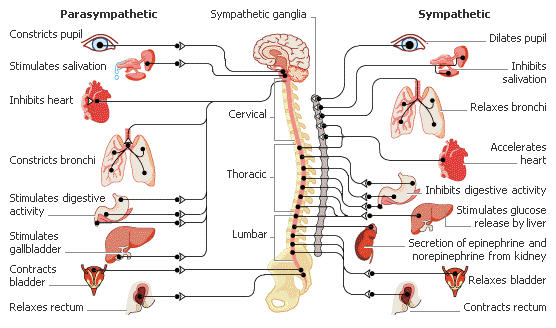
                 In addition, the peripheral nervous system is further broken down into either somatic or autonomic nervous system. The somatic nervous system is responsible for controlling the physical movement of the body through skeletal muscles. Meanwhile, the autonomic nervous system is responsible for controlling everything else. Atherosclerosis is genuinely most influenced by the autonomic nervous system.
                The autonomic nervous system can be categorized into sympathetic and parasympathetic nervous system.  There is a common approach when defining which nervous system is in action when it is defined as either  "fight or flight" and "rest and digest".
                 The following video provides a clear insight about the brain and the nervous system:

                In basic terms, the nervous systems receives a signal, analyzes it and responds accordingly.  In a more detailed perspective, when the body needs to run away from a tiger the sympathetic nervous system will kick into fight or flight response and increase heart rate to allow more oxygenated blood to reach skeletal muscles and promote movement.  Meanwhile, the parasympathetic nervous system responsible for rest and digest will slow down and restrict blood flow sent towards the digestive tract.
                Conversely, if the individual is sitting down and eating lunch they will slow down their sympathetic nervous system and increase their parasympathetic nervous system.  Henceforth, when a blood vessel is clogged the autonomic nervous can influence the severity of slowing down blood flow.
                For instance, if a water hose is clogged, but is still able to slowly churn out water is then squeezed, then the already restricted water flow will cease to exist. The same scenario exists within blood vessels during high pressures created from stress or high heart rate. Unfortunately, individuals with high stress and hypertension will further increase their likelihood of having a stroke even with a less severe case of atherosclerosis.
                 Fortunately, bypass surgery exists for those with clogged arteries that are life threatening, but a more permanent solution should be developed to prevent atherosclerosis. Among the different types of medical treatments, awareness accompanied by a healthy diet and regular exercise will greatly reduce the buildup of plaque is the best solution. 


References:
1.       American Psychiatric Association. Diagnostic and Statistical Manual of Mental Disorders. 4th ed. Washington, DC: American Psychiatric Association;2000.

2.       Korczak DJ, Goldstein BI, Levitt AJ. Panic disorder, cardiac diagnosis and emergency department utilization in an epidemiologic community sample.Gen Hosp Psychiatry 2007;29:335–9.

3.       Chen YH, Tsai SY, Lee HC, Lin HC. Increased risk of acute myocardial infarction for patients with panic disorder: a nationwide population-based study. Psychosom Med 2009;71:798–804.

4.       Bystritsky A, Craske M, Maidenberg E, Vapnik T, Shapiro D. Ambulatory monitoring of panic patients during regular activity: a preliminary report. Biol Psychiatry 1995;38:684–9.

Sunday, July 15, 2012

Update on Synthetic Blood Vessels


                Presently, a permanent solution to atherosclerosis does not exist. Although certain medications help alleviate the causation of the buildup of plaque in the arteries, extreme levels of blood clog may require a bypass surgery.  A bypass surgery typically consist of removing a healthy blood vessel from another part of the body and replacing the targeted severely clogged blood vessel.
                Bypass surgeries can be both dangerous and occasionally impossible because the patient lacks any usable healthy blood vessels to be extracted. Although there are several types of bypass surgery that may involve either stopping the heart, or not stopping the heart, both types of surgery are fairly successful by having a success rate of 95-98%. Gradually, technology will allow minimal invasive techniques that prevents a large incision of the chest and sternum.

In the following video clip, a brief animation explanation of bypass surgery is given.
                Bypass surgery is not always successful or even impractical for certain individuals. However, the theory of a synthetic blood vessel has been developed.  Individuals that do not possess any healthy blood vessels suitable for transplant  may soon experience a medication breakthrough that will allow synthetic blood vessels to permanently replace their damaged or severely clog blood vessels.
                Nevertheless, a medical breakthrough would not exist if the task is not hard solve. Currently, thousands of scientists around the world are trying to develop a synthetic blood vessel that may be suitable for implantation in a human. 

The problem of the synthetic blood vessel resides in:

1)      Can the synthetic blood vessel function exactly like an actual blood vessel?
2)      What material should the blood vessel be developed from?
i)        Would the body reject the synthetic blood vessel?
ii)       Is the material strong enough? elastic? pliable?
iii)     How long does it take to be produced?
3)      How would the synthetic blood vessel be created?
i)        Would it be grown in a culture within a Petri-dish within a laboratory?
ii)       Would it be printed through ink-jet printers?
4)      Will the new synthetic blood vessel permanently solve plaque buildup?
i)        Would the new blood vessel prevent atherosclerosis from reoccurring in the same region?
5)      Is a synthetic blood vessel practical?
i)        Will it be economically affordable?
ii)       How long will it take to be constructed?

The following video presents a research group in Germany attempting to develop artificial blood vessels that can be potentially used for human benefits.
                Although there is still plenty to learn about in the development of synthetic blood vessels, future research will allow bigger and better medical breakthroughs to be potentially discovered.  The current focus on synthetic blood vessel development revolve strongly on tissue synthesis from existing host cells that can be cultured in the laboratory through tissue engineering techniques. However, radical ideas using technologies that currently exist, such as the researchers from Germany have promising results. Researchers around the world are developing blood vessel prototypes that simply lack specific target characteristics of an authentic human blood vessel, but eventually they will be to synthesize a working blood vessel that may save the lives of thousands, or even millions around the world.


References:
1.      Amiel GE, et al. (2006) Engineering of blood vessels from acellular collagen matrices coated with human endothelial cells. Tissue Eng12:2355–2365.

2.      Kaushal S, et al. (2001) Functional small-diameter neovessels created using endothelial progenitor cells expanded ex vivo. Nat Med 7:1035–1040.

3.      McKee JA, Banik SS, Boyer MJ, Hamad NM, Lawson JH, Niklason LE, Counter CM. Human arteries engineered in vitro. EMBO Rep. 2003; 4: 633–638.

4.      Whittemore AD, Kent KC, Donaldson MC, Couch NP, Mannick JA. What is the proper role of polytetrafluoroethylene grafts in infrainguinal reconstruction? J Vasc Surg. 1989; 10: 299–305.


Tuesday, July 10, 2012

Introduction to Atherosclerosis and myself

Hi everyone,

                      My name is Raymond Wu and I am currently an undergraduate student at San Francisco State University currently majoring in biology with concentration in physiology. I enjoy learning about new scientific methods and the potential practicality in which they can be applied. Among them is the topic of atherosclerosis.
            Atherosclerosis is the thickening of arterial walls created by the buildup of plaque. Although this terminology may be new to some, it is the major cause of human related deaths in the United States. This disease even peaks over cancer and tobacco death rates. Atherosclerosis itself does not immediately kill its host, but is the leading cause of cardiovascular problems which develops gradually into a hazardous health problem. So why is this important? Simply because each and every single individual has this disease gradually building up despite how healthy you may appear, but is only a matter of time when it peaks the allowed blockage of your arteries and you can no longer send fresh oxygenate blood throughout your body. Then BAM! You are either having a stroke, or you probably do not know it because you are already dead.
            The purpose of this blog is to discuss the practicality of potential treatments of atherosclerosis. Currently I understand that although atherosclerosis is not curable, but rather only treatable.

Treatments include:
·         Medications that lower the arterial pressure by inducing changes in the heart with calcium-channel or beta blockers, and angiotension-converting enzyme inhibitors
·         Surgery which involve angioplasty and stent placement, endarterectomy, and bypass surgery.      
             
Potential treatments still under research:
·         Synthestic blood vessels

            I would like this blog to discuss the opinions of the best potential treatment, or a combination of treatments, for atherosclerosis. Personally, I prefer the idea of a synthetic blood vessel that may be transplanted into the affected area without having to perform a bypass surgery of removing a healthy blood vessel from another part of the body to replace the clogged one.
             If you agree with me about the synthetic blood vessel, what would be your opinion of the best material to be used to construct the vessel. The idea of embryonic stem cells from the actual patient that needs the vessel being used to synthesize their own blood vessel may probably reduce the chance of  the body rejecting the newly implanted tissue.
            What is your opinion on the subject matter?


References:
Aronow, W. S. (2011). Osteoporosis, osteopenia, and atherosclerotic vascular disease. Arch Med Sci. , 7(1), 21-26. doi: 10.5114/aoms.2011.20599
Butcher, M. J., & Galkina, E. V. (2012). Phenotypic and functional heterogeneity of macrophages and dendritic cell subsets in the healthy and atherosclerosis-prone aorta. Front Physiol, 3, doi: 10.3389/fphys.2012.00044
Li, J. (2011). Inflammation in coronary artery diseases.Chinese Medical Journal, 124(21), 3568-3575. Retrieved from http://www.cmj.org/Periodical/paperlist.asp?
Mercando, A.D., et al (2012):. Reduction in atherosclerotic events: a retrospective study in an outpatient cardiology practice. Arch Med Sci. . 8.1, 57-62. Retrieved from <http://www.ncbi.nlm.nih.gov/pmc/articles/PMC3309438/?tool=pubmed>.
Niessner, A., & Weyand, C. M. (2009). Dendritic cells in atherosclerotic disease. Clin Immunol, 134(1), doi: 10.1016/j.clim.2009.05.006
Twigg, M.W., K. Freestone, et al( 2012):. The LOX-1 Scavenger Receptor and Its Implications in the Treatment of Vascular Disease." Cardiol Res Pract.. 2012. Retrieved from <http://www.ncbi.nlm.nih.gov/pmc/articles/PMC3290926/?tool=pubmed>.
Widmaier, Eric P., et al (2011). Vander's Human Physiology: The Mechanisms of Body Function. 12th ed. New York: McGraw Hill, 2011. 414-16.
Zacharias, D. G., and et al. (2012). Humanin, a cytoprotective peptide, is expressed in carotid artherosclerotic plaques in humans. PLoS One, 7(2), Retrieved from http://www.ncbi.nlm.nih.gov/pmc/articles/PMC3273477/?tool=pubmed